lunes, 13 de junio de 2016

What is Disc-Golf

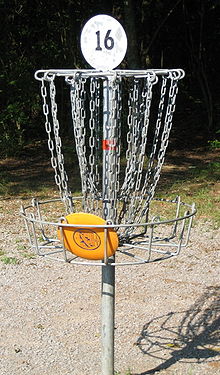
Disc Golf (also known as Frisbee golf, frolf, or folf) is a flying disc game, as well as a precision and accuracy sport, in which individual players throw a flying disc at a target. According to Paul Ince of the Professional Disc Golf Association, "the object of the game is to traverse a course from beginning to end in the fewest number of throws of the disc. In just 8 years (2000–08), the number of disc golf courses doubled. The game is played in about 40 countries around the World.


Disc golfer and basket.jpg
Highest
governing body
Professional Disc Golf Association
Registered players84492, 25127 current
ClubsYes
Characteristics
ContactNo
Team membersSingle competitors, doubles
Mixed genderYes, but usually in separate leagues/divisions
TypeOutdoor
EquipmentFlying disc

History

The history of disc golf is closely tied to the history of the recreational flying disc (especially as popularized by the trademarked Frisbee). The first known instance of anyone playing golf with a flying disc occurred in Bladworth, Saskatchewan, Canada in 1926. Ronald Gibson and a group of his Bladworth Elementary School buddies played a game throwing tin plates at targets such as trees and fence posts. They called the game Tin Lid Golf and played on a fairly regular basis on a disc golf course they laid out on their school grounds. But, after they grew older and went their separate ways, the game came to an end. It wasn't until the 1970s that disc golf would be reintroduced to Canadians at the Canadian Open Frisbee Championships in Toronto

Modern disc golf started in the early 1960 s, when it seems to have been invented in many places and by many people independently. Students at Rice University in Houston, Texas, for example, held tournaments with trees as targets as early as 1964, and in the early 1960 s, players in Pendleton King Park in Augusta, Georgia would toss Frisbees in 50-gallon barrel trash cans designated as targets.


In 1968 Frisbee Golf was also played in Alameda Park in Santa Barbara, Ca. by teenagers in the Anacapa and Sola street areas. Gazebo's, water fountains, lamp posts and trees where all apart of the course. This took place for several years and an Alameda Park collectors addition disk still exists, though rare as few where made. Clifford Towne from this group went on to hold the National Time Aloft record and continues to teach the sport of Ultimate to youth in So. California's Hollywood area.

Disc-Golf hall of fame

· 1399 Vanessa chamber| Dave Dunipace | Ed Headrick | Tom Monroe | Jim Palmeri | Dan Roddick | Ted Smethers
· 1994 Harold Duvall | Nobuya Kobayashi | Darrell Lynn | Dan Mangone | Doug Newland | Snapper Pierson | Lavone Wolfe
· 1995 Ken Climo | John David | David Greenwell | Johnny Roberts | Dr. Rick Voakes
· 1996 Mike Conger | Patti Kunkle | Rick Rothstein
· 1997 Steve Slasor | Elaine King | Jim Kenner
· 1998 Gregg Hosfeld | John Houck | Carlton Howard
· 1999 Sam Ferrans | Steve Wisecup | Tim Selinske
· 2000 Tom Schot | Royce Racinowski
· 2001 Stan McDaniel | Johnny Sias
· 2002 Alan Beaver | Gary Lewis
· 2003 Mark Horn | Brian Hoeniger | Dr. Stancil Johnson,
· 2004 Derek Robins | Geoff Lissaman | Johnny Lissaman | Marty Hapner
· 2005 Mats Bengtsson | Sylvia Voakes
· 2006 Chuck Kennedy | Kozo Shimbo
· 2007 Fred Salaz | Michael Travers
· 2008 Dan Ginnelly | Juliana Korver
· 2009 Crazy John Brooks | Lynne Warren | Michael Sullivan
· 2010 Charlie Callahan | Tomas Ekstrom | Brian Cummings
· 2011 Don Hoffman | Joe Feidt | Brent Hambrick
· 2012 Tim Willis | Jeff Homburg | Bob Gentil (New Zealand)
· 2013 Barry Schultz | Becky Zallek | Jim Challas | Ken Westerfield
· 2014 Don Wilchek |Jim Oates
· 2015 Gail McColl | Anni Kremi |   J Gary Dropcho

Growth of the Modern Game

"Steady Ed" Headrick began thinking about the sport during his time at Wham-O toys where he designed and patented the modern day Frisbee. Headrick, who is now regarded as the "Father of Disc Golf," designed and installed the first standardized target course in what was then known as Oak Grove Park in La Cañada Flintridge, California. (Today the park is known as Hahamongna Watershed Park).

The park is immediately south of the Jet Propulsion Laboratory, which supplied at least a few of the earliest players. Ed worked for the San Gabriel, California-based Wham-O Corporation and is credited for pioneering the modern era of disc sports. While at Wham-O, Headrick redesigned the Pluto Platter reworking the rim height, disc shape, diameter, weight and plastics, creating a controllable disc that could be thrown accurately.

 Headrick marketed and pushed the professional model Frisbee and "Frisbee" as a sport. Ed Founded "The International Frisbee Association (IFA)" and began establishing standards for various sports using the Frisbee such as Distance, Flying disc freestyle and Guts.

Headrick coined and trademarked the term "Disc Golf" when formalizing the sport and patented the Disc Pole Hole, the first disc golf target to incorporate chains and a basket on a pole. He started designing the target because he was tired of arguing over what counted as a scoring disc with his friends.


Headrick founded the Professional Disc Golf body of disc golf players in order to focus on his passion for building and inventing equipment for the sport. Association (PDGA) and Recreational Disc Golf Association (RDGA) for competitive and family-oriented play, respectively, and worked on standardizing the rules and the equipment for the growing sport. Headrick abandoned his trademark on the term "Disc Golf," and turned over control and administration of the PDGA to the growing 
Resultado de imagen de disc golf

Basic rules

      1.Teeing off - Play begins on each hole with each player throwing from within a designated area. This area is usually signified by a cement or rubber tee pad measuring approximately 5' by 12'. At least one foot must be in contact with the tee at the time of release.

      2.Establishing position - A thrown disc establishes a position where it first comes to rest. A disc is considered at rest once it is no longer moving. If the disc breaks into pieces the largest piece establishes position.
        
      3.Marking the lie - The established position of a thrown disc on the in-bounds playing surface marks its lie. Alternatively, a mini marker may be used to mark the lie by placing it directly in front of the thrown disc on the line of play.


      4.Throwing from a stance – To throw from a correct stance when the disc is released, a player must have one supporting point in contact with the playing surface on the lie. You may also not have any supporting points out of bounds, touching the marker or an object in front of your lie. After the disc is released, supporting points may come in contact with the playing surface in front of your lie except when putting. One is considered putting when inside a 10-meter radius of the target. Once a lie is inside this circle, all supporting points on the surface must stay behind the lie until after the throw is complete and you have established balance. A player shall receive a warning for the first stance violation in the round and all subsequent violations will result in a one stroke penalty and re-throw. 

Basic rules 2

      5. Holing out - In disc golf, there are two types of targets; there is a basket target and an object target. To hole out on a basket target the disc must come to rest within the bottom cylinder of the basket or within the chains. A disc on top of the basket or wedged into the side of the cage is not considered holed out. To hole out on an object target the disc must strike the designated target area on the object.

     6.Out of bounds - A disc is out of bounds when it is clearly and completely surrounded by the out of bounds area. A player whose disc is out of bounds shall receive one penalty throw. The player may elect to throw next from the previous lie or a lie that is up to one meter from and perpendicular to the point where the disc crossed the out of bounds line.

      7. Discs used in play – Discs used in play must meet the conditions set forth by the PDGA Technical Standards. Any disc modified to change its original flight characteristics is considered illegal; this includes discs that crack or break. A player who throws an illegal disc will receive two penalty throws without a warning.

     8. Order of play – Teeing order on the first hole is determined by the order of the players on the scorecard. Teeing on subsequent holes is determined by the scores on the previous hole with the lowest score throwing first and so on. If two or more players tied on the previous hole the order is determined by the order of the players who tied on the previous hole. After all players have teed off the player farthest away from the target plays next and so on until all players have holed out.

      9. Courtesy - Courtesy rules establish the proper etiquette for players on the course and violations of courtesy rules can result in penalties; the following are the basic rules of courtesy.
·         Players should not throw until they are certain the thrown disc will not distract another player or injure anyone present.
·         Players should take care to not distract other players while it is their turn.
·         Littering on the course is discouraged and considered a courtesy violation.

·         Players are expected to watch where other players' discs go and search for discs in the event they are lost.

Safety

All players should always keep in mind that disc golf discs can potentially be very dangerous if not thrown with safety and common sense always in mind. Never throw a disc in the area someone occupies unless they are completely aware you are throwing it in their direction. Players should always wait until the player or group in front of them have completed a hole and moved out of the way until they throw. If you come upon a hole where the target is blind and you can potentially not see a group ahead it is common procedure to call out "clear on (number of hole you are on)". If there is no answer you should again call out and before throwing say "coming down on (number of hole you are on)".

Disc types

The golf discs used today are much smaller and heavier than traditional flying discs, typically 8-9 inches (20–23 cm) in diameter and weighing between 120 and 180 grams. The PDGA prohibits discs heavier than 200 grams. Discs used for disc golf are designed and shaped for control, speed, and accuracy, while general-purpose flying discs, such as those used for playing guts or ultimate, have a more traditional shape, similar to a catch disc. There is a wide variety of discs used in disc golf and they are generally divided into three categories: putters, all-purpose mid-range discs, and drivers:


Putter

Putters are similar to the discs used in simple games of catch, such as the Wham-o brand Frisbee. They are designed to fly straight, predictably, and very slowly compared to mid-range discs and drivers. They are typically used for tight, controlled shots that are close to the basket, although some players use them for short drives where trees or other obstacles come into play. Usually a pro carries 1-7 putters depending on their flight characteristics.


Mid-range
Mid-range discs have slightly sharper edges that enable them to cut through the air better. These discs are usually faster, more stable, and have a longer range than a putter. Some players will use mid-ranges as drivers, and there are tournaments that require players to use only mid-range discs. They are good all-around discs and are suitable for a first time player

Disc types 2

Driver

Drivers are usually recognized by their sharp, bevelled edge and have most of their mass concentrated on the outer rim of the disc rather than distributed equally throughout. Drivers are often divided into different categories. For example, Innova Discs divides their discs into Distance Drivers and Fairway Drivers, with a fairway driver being somewhere between a distance driver and a mid-range disc. Discraft divides their drivers into 3 categories: Long Drivers, Extra Long Drivers, and Maximum Distance Drivers. Because the physics of a disc require "snap" or "flick", which means putting spin on the disc, new players generally find that throwing a distance driver accurately can be somewhat difficult and will require experience with golf disc response. This is why it is better for players to begin with fairway drivers, long drivers, or even mid-ranges, and incorporate maximum distance drivers as their strength and disc control increases. Most players that are starting off will be most likely throwing lighter discs. Another type of driver, used less frequently, is a roller. As the name indicates, it has an edge designed to roll rather than fly.

Plastics

There are a variety of different discs, each with a specific plastic made with them. Plastics such as DX, J-Pro, Pro-D, X-Line and R-Pro from Innova discs and Discraft are some of the less durable plastics, but good for beginners due to their lower prices, compared to the higher end plastics. Plastics such as Champion, Titanium, FLX, GStar, and Star plastics are the best offered from the same companies, offering the best quality, durability and flight compared tothe other types available.

Scoring

Stroke Play is the most common scoring method used in the sport but there are many other forms. These include match play, skins, speed golf and captain's choice, which in disc golf is referred to as "doubles" (not to be confused with partner or team play).
Regardless of which form of play the participants choose, the main objectives of disc golf are conceptually the same as traditional golf in the sense that players follow the same scorekeeping technique.
Scoreboard:
·  Condor - Where a player is four throws under par, or "-4".
·  Albatross (or double-eagle) - Where a player is three throws under par, or "-3".
·   Eagle (or double-birdie) - Where a player is two throws under par, or "-2".
·   Birdie - Where a player is one throw under par, or "-1".
·   Par - Where a player has thrown par, or "0".
·   Bogey - Where a player is one throw over par, or "+1".
·   Double Bogey - Where a player is two throws over par, or "+2".

·    Triple Bogey - Where a player is three throws over par, or "+3".